How FMCG brands can use genuine shopper feedback to improve product launches, strengthen retailer performance and make better commercial decisions.
Launching a new grocery product requires significant investment in distribution, advertising, promotions and packaging. Yet even a well-supported launch can struggle if shoppers reach a retailer website and find little useful feedback about the product.
Reviews help shoppers decide whether something unfamiliar is worth trying. They also tell brands what customers think once the product reaches the shelf.
For FMCG teams, shopper review analytics is valuable both before and after launch. It helps brands understand the category, monitor product performance and act on feedback while there is still time to make a difference.
CheckoutSmart's research shows that recent, visible reviews can matter more to shoppers than small differences in average star ratings.
A product with a good overall rating can still create doubt if its latest reviews are old, unrepresentative or focused on unresolved problems.
Getting reviews is therefore only part of the job. Brands need to understand them and keep them current.
Key takeaways
- Understand the shopper experience: Identify what customers like, dislike and expect.
- Look beyond star ratings: The words in recent reviews can influence purchase decisions.
- Track three measures: Maintain at least 30 reviews per SKU per retailer, with fresh and representative Top 3 reviews.
- Plan around your launch: Align review collection with advertising, distribution and promotional activity.
- Turn feedback into action: Use shopper insights to inform product development, marketing and retailer conversations.
 What Is Shopper Review Analytics?
Shopper review analytics involves collecting, measuring and analysing product reviews to understand how shoppers experience your products.
For grocery brands, this means examining feedback across retailer websites such as Tesco, Sainsbury's, ASDA, Morrisons and Ocado.
The analysis goes beyond counting reviews or tracking an average rating. It examines review volume, freshness, sentiment, recurring themes and competitor performance.
Two products may both have a 4.2-star average. One might receive excellent feedback about taste but repeated complaints about packaging. The other may be praised for convenience but criticised for value. Their average ratings are similar. The commercial implications are different.
Review analytics helps brands identify these differences and make better decisions about product formulation, packaging, positioning and marketing.
Why stars tell only part of the story
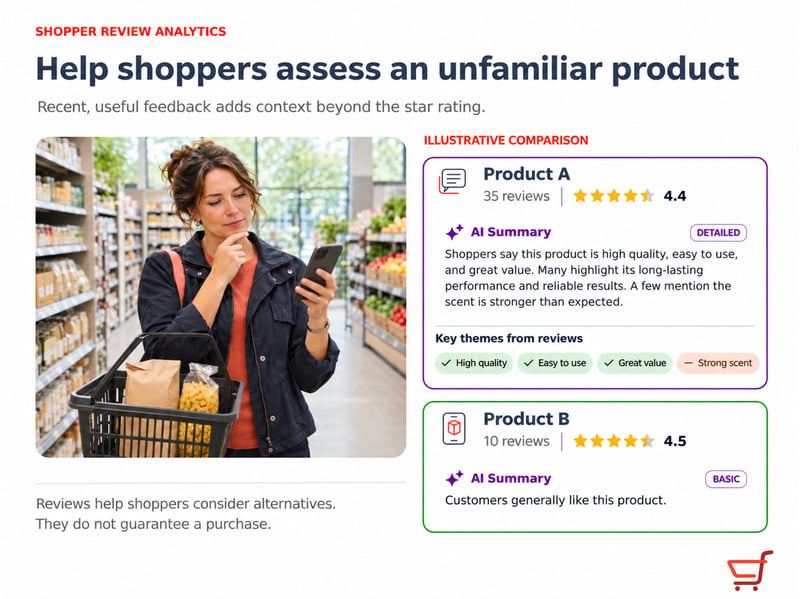
Imagine a product with a 4.5-star average, but its three most recent reviews describe disappointing texture or packaging problems. That may be the feedback a shopper notices first.CheckoutSmart's Stories not Stars research shows that shoppers do not always distinguish meaningfully between products with average ratings of four stars and above. Once a product has a credible rating, the content of visible reviews becomes particularly influential.
Shoppers want to know whether something tastes good, works as promised, offers value for money or meets their needs. A star rating cannot answer those questions on its own.
Why Review Analytics Matters for Grocery Launches
New product development carries considerable risk. Brands invest in distribution and awareness, but early shopper feedback can influence trial and repeat purchase.
Review analytics helps answer practical questions. Does the product deliver the expected taste? Is its packaging convenient? Does the price feel justified? Are shoppers using it for the intended occasion?
Reviews and retailer readiness
Retailers need evidence that a new product has the potential to succeed. Sales, distribution and promotional performance remain central measures. Reviews add another perspective: what people who have tried the product actually think.
A new product with 30 genuine reviews provides more substantial feedback than one with only two or three. This can support conversations with category buyers, particularly when reviews highlight benefits that distinguish the product from competitors. Review metrics do not replace sales data. They help explain the shopper experience behind it.
The influence on online and in-store shopping
On supermarket websites, shoppers can compare products within seconds. Images, prices and promotions influence that decision. Reviews add the experiences of other purchasers.
A familiar product may need little reassurance. A new brand, flavour or premium-priced alternative has more to prove. Reviews also matter in-store. Shoppers research products before visiting supermarkets, and some check reviews on their phones while shopping.
Product reviews should therefore be part of the wider launch strategy, not simply an eCommerce task.
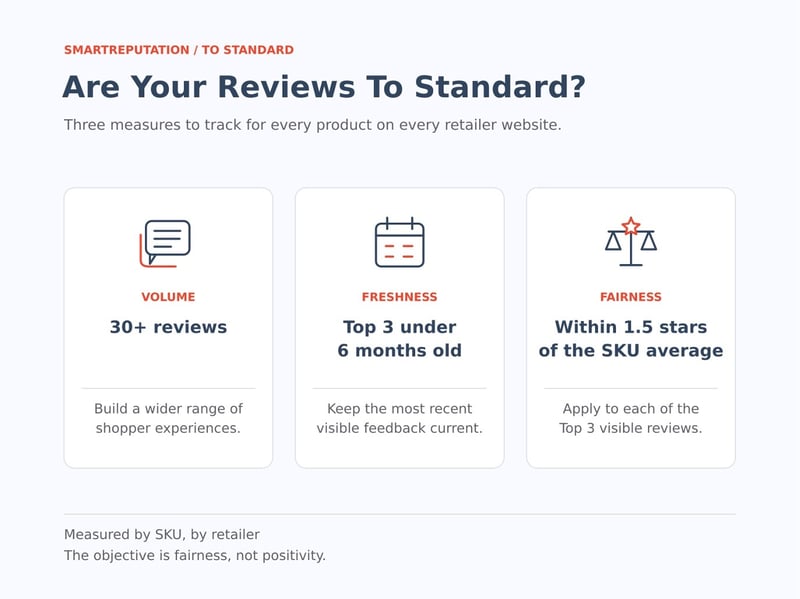
The Three Core Metrics Every Brand Should Track
CheckoutSmart uses a clear methodology to assess whether a product's reviews are To Standard.
CheckoutSmart assesses each SKU separately on every retailer website because review performance can vary significantly between retailers.
1. Volume: At least 30 reviews
CheckoutSmart recommends at least 30 reviews per SKU per retailer.
This gives shoppers a wider range of experiences to consider and helps an unfamiliar product establish credibility.
For launches, reaching this threshold should be part of the initial commercial plan.
2. Freshness: Top 3 reviews under six months old
Shoppers want to know what people think about the product now.
Older reviews may refer to a previous recipe, different packaging or an earlier version of the product.
CheckoutSmart recommends that none of the three most recent visible reviews should be more than six months old.
3. Fairness: Top 3 reviews representative of the average
The Top 3 visible reviews should reflect the product's wider rating.
CheckoutSmart considers a review unrepresentative when its rating differs by more than 1.5 stars from that SKU's average on the retailer website.
For example, unusually negative recent reviews could create a misleading impression of a product with a strong overall rating.
The principle applies equally to unusually positive reviews.
The objective is fairness, not positivity. CheckoutSmart does not remove or suppress negative reviews. Instead, CheckoutSmart collects additional genuine feedback when the Top 3 are unrepresentative.
Together, these three measures offer a practical way to maintain review quality throughout the year.
Building a Review Analytics Strategy for Your Grocery Launch
Review analytics works best when it is included in launch planning rather than introduced once sales begin to disappoint.
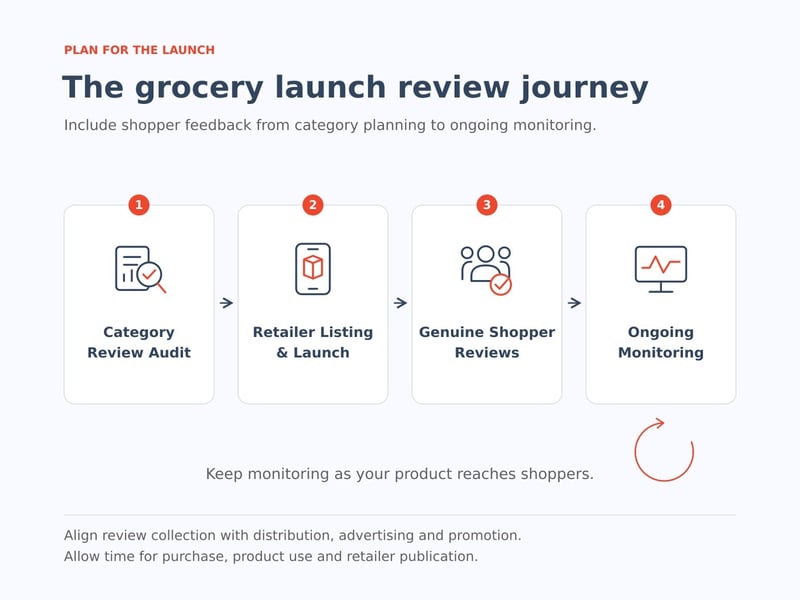
A practical approach has four stages.
Step 1: Establish your competitive baseline
Before launch, assess the products your new SKU will compete against. Compare review volume, average ratings, freshness and written feedback.
Identify which products are well represented and which have gaps. Most importantly, examine what shoppers say.
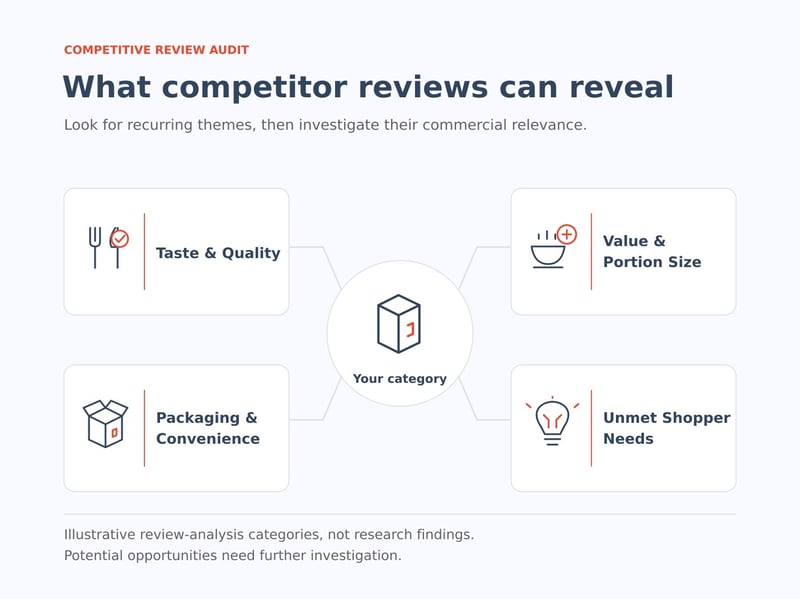
Reviews of ready meals, for example, might reveal recurring comments about portion size, texture, convenience or value. These are illustrative themes, but they show the information a category audit can uncover.
Use competitor reviews to identify unmet needs
Competitor reviews show how shoppers experience products already available in the category. If several products attract similar complaints, those comments may point to a gap in the market.
If shoppers repeatedly praise a particular feature, that may indicate a benefit worth protecting or improving. Review analysis can inform decisions about taste, ingredients, packaging, product formats and usage occasions. These findings should guide further investigation rather than be treated as proof that an opportunity will succeed.
 Step 2: Align review collection with your launch calendar
If advertising creates awareness but retailer listings contain no useful reviews, shoppers may lack the reassurance needed to try an unfamiliar product.
Plan review collection alongside distribution, advertising and promotional activity. Allow time for shoppers to buy the product, use it, leave feedback and for retailers to publish the reviews.
For most SKUs in a new SmartReputation Always On programme, CheckoutSmart expects the first reviews by approximately week six, with products typically reaching To Standard within 12–16 weeks. Timings depend on availability, retailer processes and shopper demand.
Step 3: Monitor sentiment during launch
A packaging problem, unexpected taste response or concern about value could affect shopper perceptions. Monitor both positive and negative feedback.
Are shoppers praising flavour but criticising texture? Are they satisfied with quality but disappointed by portion size?
The reason behind a rating is often more useful than the rating itself.
Step 4: Turn the findings into action
Repeated packaging complaints should reach the product team. An unexpectedly popular benefit may deserve more attention in marketing.
Differences between retailers should prompt commercial investigation. Review analytics creates a continuing feedback loop between shoppers and the teams responsible for the product.
How to Generate Reliable Shopper Reviews
Brands have several options for building review coverage, but the speed, quality and work involved vary.
Organic review collection
Organic reviews arrive when shoppers independently choose to share their experiences. They are valuable, but they can take time to accumulate.
CheckoutSmart's analysis has found that a typical SKU on Tesco can take about 18 months to accumulate 30 organic reviews.
For a new product, that may be too slow to provide meaningful coverage during its first year.
Cashback-supported product trial
A managed product-trial programme can accelerate genuine feedback.
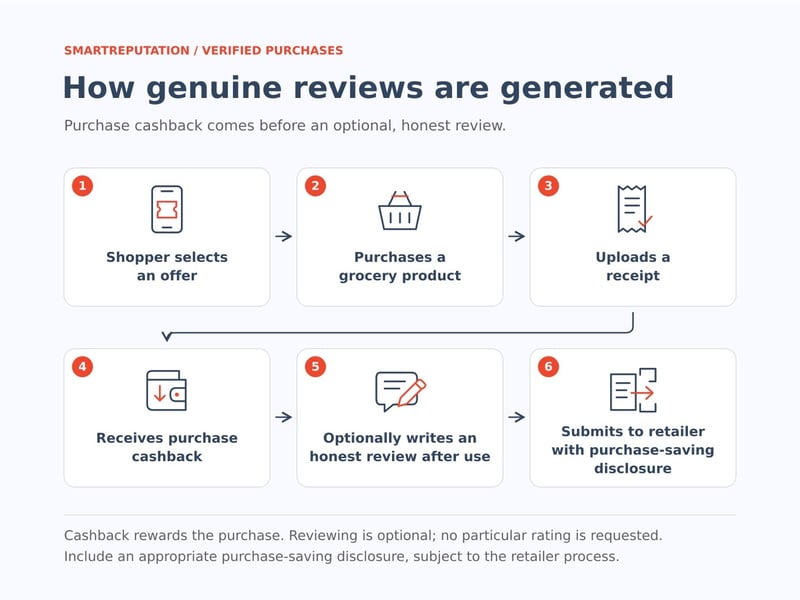
CheckoutSmart's SmartReputation service works with members who choose products they want to try, purchase them and upload receipts to verify their purchase.
Cashback is awarded for buying the product. After receiving cashback and using the product, members may be invited to leave an honest review.
Leaving a review is optional. Shoppers are not rewarded for reviewing the product or providing a particular rating.
The aim is genuine feedback from verified purchasers, not a guaranteed positive score.
This distinction matters for shopper trust, authenticity and compliance.
How Review Analytics Complements Traditional Consumer Research
Traditional research and review analytics answer different questions. Focus groups, surveys and panels allow brands to test specific ideas, ask targeted questions and investigate concepts before launch.
Review analytics examines feedback arising from actual product use. That can reveal details a brand may not have thought to ask about, such as storage problems, unexpected usage occasions or packaging frustrations.
It also provides ongoing feedback as shoppers buy and use products, rather than only at scheduled research stages.
AI-supported analysis makes it possible to examine large volumes of reviews across multiple retailers and competing products.
However, reviews are written by self-selecting shoppers and may not represent the wider population.
The strongest approach is to use review analysis alongside structured research, allowing each to inform the other.
The Role of AI in Shopper Review Analytics
A large FMCG portfolio can generate thousands of reviews across several retailers. Reading every comment manually is time-consuming.
AI-supported text analysis can organise this information, identify recurring themes and highlight meaningful changes.
Understanding sentiment beyond positive and negative
A shopper might praise a product's flavour while criticising its packaging. Another may appreciate its convenience but question its price. Both reviews contain mixed sentiment.
Detailed analysis can identify which attributes shoppers are discussing and whether their views are favourable or critical. This provides more useful information than assigning every review a single positive or negative label.
Identifying themes and opportunities
AI can group comments about taste, texture, value, convenience, packaging and ingredients. Brands can then compare those themes across SKUs, retailers, competitors and time periods.
CheckoutSmart's SmartInsights approach helps teams identify recurring product strengths, complaints and potential areas for improvement.
For example, analysis might reveal consistently positive responses to one flavour variant but mixed feedback about another. The value comes from combining the patterns with the original review text, so teams understand the context.
Spotting problems early
Review trends can also act as early-warning signals. An increase in packaging complaints, ageing Top 3 reviews or a decline in review activity may indicate that action is needed.
Automated monitoring can flag some issues before review performance falls below standard.
However, review data cannot predict sales success on its own. Pricing, promotion, distribution and competition all affect performance.
Turning Review Data into Better Commercial Decisions:
Competitive benchmarking
Review performance needs category context. A 4.3-star average may look strong, but it tells you little about how the product compares with alternatives.
Benchmark volume, freshness, average rating and sentiment against direct competitors.
A product with strong reviews but recurring packaging complaints needs different action from one that simply lacks review coverage.
Identifying unmet needs
Negative reviews can be particularly informative. Repeated complaints about portion sizes, packaging or convenience may reveal unmet shopper needs.
If the same problems appear across competing brands, they may suggest an innovation opportunity.
The commercial importance of that opportunity still needs testing.
Validating marketing claims
Reviews can show whether the product experience matches its marketing. If shoppers repeatedly praise a benefit featured on the packaging, that supports the proposition.
If their feedback tells a different story, the brand may need to examine its communication or the product itself.
Common Mistakes in Grocery Review Analytics
Several mistakes can reduce the value of review data.
-
Focusing only on star ratings. Average ratings hide the reasons behind satisfaction or dissatisfaction. Analyse the written feedback, especially the most visible reviews.
-
Ignoring freshness. Collecting 30 reviews once does not mean the product will remain To Standard. Reviews age, and the Top 3 can change.
-
Treating all retailers alike. A SKU may have strong coverage on Tesco but needs support on Sainsbury's. Monitor each retailer separately.
-
Overlooking competitors. Your review position can weaken even when your own metrics stay the same. Competitors may gain newer reviews, launch improved products or address shopper complaints more effectively.
An ongoing review programme helps brands avoid these gaps.
Connecting Review Analytics to Commercial Performance
Brand teams need evidence that review activity contributes to business results. The strongest approach is to examine reviews alongside sales and conversion data.
Compare supported SKUs with suitable controls
CheckoutSmart has assessed the impact of SmartReputation Always On by comparing products receiving review support with those outside the programme.
In its work with Lactalis, the programme reported 13% higher online sales for supported SKUs compared with non-Always On products.
CheckoutSmart has reported returns of 6–12 times programme investment at gross margin level across client work.
These results are specific to the programmes assessed, not guaranteed outcomes for every brand.
Prices, promotions, distribution and other factors should be considered when interpreting sales differences.
Assess online conversion and retailer performance
Where data is available, compare product-page conversion before and after improvements in review coverage. Look at review volume, freshness and sentiment alongside commercial results.
Review improvements may support sales, but changes should not automatically be attributed to reviews when other commercial factors have changed.
Strengthen retailer conversations
Review data can also support category discussions. A brand can show that a product has credible review volume, current feedback and genuine shopper appreciation of particular benefits.
This gives commercial teams additional evidence alongside sales and distribution data.
What a Useful Review Analytics Dashboard Should Show
A dashboard should make it easy to identify products needing attention without manually checking every retailer page.
The essential elements are:
- SKU-level status: Review count, average rating and whether the Top 3 meet freshness and fairness requirements.
- Trends over time: Changes in review coverage, ratings and recurring sentiment.
- Competitive comparison: How products perform against relevant alternatives.
- Action alerts: Products with fewer than 30 reviews, Top 3 reviews older than six months, or ratings differing by more than 1.5 stars from the average.
Clear red, amber and green status indicators can help teams prioritise action.
CheckoutSmart SmartReputation Always On uses daily monitoring and automatic triggers to manage To Standard performance across agreed SKUs and retailers. The aim is to show brands what needs attention while reducing manual work.
Building Review Analytics into Your Team
Review insights are relevant to several business functions. Brand managers need to understand overall performance. eCommerce teams manage retailer activity. Product teams investigate complaints, while commercial teams use shopper evidence in customer discussions.
Without clear ownership, useful information can easily go unused. Assign responsibility for reviewing performance and coordinating action. Share the main findings regularly, focusing on what has changed, what matters and what the team intends to do.
If working with an external partner, agree the SKUs, retailers, reporting requirements and success measures at the start. CheckoutSmart's Always On approach is designed to reduce the operational burden through automated monitoring and managed review generation. This allows internal teams to focus on interpreting shopper feedback and making decisions.
Compliance and Authenticity in Review Programmes
Review programmes must protect shopper trust. UK consumer protection requirements, including provisions introduced under the Digital Markets, Competition and Consumers Act 2024, place particular attention on fake reviews and misleading review practices.
Retailers also have their own publication policies.
Genuine reviews from genuine purchasers
CheckoutSmart members buy products themselves and provide proof of purchase. They receive cashback for the product purchase, not for leaving a review.
After trying the product, they may choose to share honest feedback. No particular rating is requested, and negative reviews are not suppressed.
Transparent purchase disclosures
Where a shopper has received a saving connected with the purchase, the arrangement should be explained appropriately. CheckoutSmart uses disclosures designed to make the purchase-saving relationship clear, subject to the relevant retailer process.
Brands should seek legal or compliance advice on the requirements affecting their programmes.
Respect retailer policies
Different retailers have different rules for review publication and moderation. A review method accepted by one platform may not be suitable for another.
Brands should account for these requirements when planning collection activity and delivery timings.
Scaling Review Analytics Across Large FMCG Portfolios
Managing a handful of products is straightforward. Managing hundreds of SKUs across multiple retailers requires a consistent approach.
Prioritise commercially important products
New launches, core products and SKUs receiving significant marketing investment may need closer attention. Use sales contribution, launch timing and distribution to establish priorities. A consistent To Standard methodology should still apply across the wider portfolio.
Automate monitoring and review collection
Manual checking becomes difficult when every SKU needs monitoring across several websites. CheckoutSmart SmartReputation Always On monitors agreed products daily.
When a SKU falls below standard for volume, freshness or fairness, further verified review collection is triggered.
Monitoring continues throughout the programme, helping brands maintain review coverage without repeatedly organising one-off campaigns.
Report at the right level
Senior teams need a portfolio overview. Category teams need competitive comparisons. Brand managers need SKU-level detail and clear actions.
A shared reporting framework provides consistent measures while allowing each team to focus on its responsibilities.
Making Review Analytics Part of Your Launch Plan
Grocery brands already monitor sales, distribution, pricing and promotional performance closely.
Reviews deserve similar attention because they reveal how shoppers experience products and whether their online reputation is supporting wider brand activity.
The priorities are clear: start with a competitive audit, set review targets by SKU and retailer, plan collection around launch activity and keep monitoring sentiment.
Getting to 30 reviews is a valuable first step. Keeping the Top 3 fresh and representative is an ongoing task.
CheckoutSmart supports this through two complementary services:
-
SmartReputation helps brands generate genuine verified-purchase reviews and maintain review volume, freshness and fairness through continuous monitoring.
-
SmartInsights helps teams understand shopper sentiment, category performance, recurring complaints and opportunities for improvement.
Together, these services give FMCG teams a clearer view of how their products are being received and a practical approach to maintaining review quality.
Review analytics cannot guarantee a successful launch. It can help brands identify problems earlier, understand what shoppers value and make better-informed decisions throughout a product's life.
FAQs: Shopper Review Analytics for Grocery Launches
How many reviews should a new grocery product have?
CheckoutSmart recommends at least 30 reviews per SKU per retailer. The Top 3 reviews should also be less than six months old and within 1.5 stars of the SKU's average rating.
What matters more: star ratings or review sentiment?
Both matter. Ratings provide a quick summary, while written reviews explain the shopper experience. CheckoutSmart's research indicates that once products have credible ratings of four stars or more, the content of visible reviews becomes particularly influential.
How quickly do grocery reviews become stale?
CheckoutSmart recommends that the Top 3 visible reviews should all be under six months old. Older feedback may be less relevant, especially if the product or packaging has changed.
Can review analytics predict which products will succeed?
Review analytics can identify shopper reactions and early warning signs, but it cannot predict commercial success on its own. Distribution, pricing, competition, promotion and product quality also matter.
How do cashback-supported reviews work?
CheckoutSmart members choose products, purchase them and verify their purchase with a receipt. Cashback is awarded for buying the product. Members may then choose to leave an honest review, but reviewing is optional and no particular rating is encouraged.
What ROI can brands expect?
CheckoutSmart has reported returns of 6–12 times programme investment at gross margin level across client work. In its Lactalis programme, supported SKUs recorded 13% higher online sales than non-Always On products. Results vary and are not guaranteed.
Should brands monitor competitor reviews?
Yes. Competitor reviews provide context for your own performance and can reveal common complaints, product strengths and unmet shopper needs.
Can review analytics replace traditional research?
No. Reviews offer continuous feedback from actual product users, but reviewers are self-selecting. Combining review analysis with structured consumer research produces a stronger basis for decisions.
Want to Understand How Your Products Compare?
CheckoutSmart can help assess review coverage across your products and retailers, identify gaps against the To Standard methodology and understand the shopper feedback shaping your category.
Contact sales@checkoutsmart.com to discuss SmartReputation, SmartInsights or a review audit for your next grocery launch.