We analysed 410 real UK consumer questions about spirits and the AI answers they received through our AI User Consumer Panel. What surprised me was how quickly fairly ordinary questions turned out to be much closer to a buying brief. Some started with something as broad as "What is the best gin?" and then immediately added a budget, a cocktail, a taste, an occasion or a concern about alcohol.
Reading through them, you can see AI doing some of the narrowing that might once have happened across several searches, retailer sites and reviews. AI does not carry every journey through to the end. It is quite willing to recommend a bottle, but much less consistent about telling the shopper where to buy it. The brand picture is also messier than a simple market‐share view would suggest.
Looking across the 410 questions, that was the pattern I kept coming back to. Shoppers are not simply receiving a list of links. They are having a buying conversation.
Numbers that caught our eye:
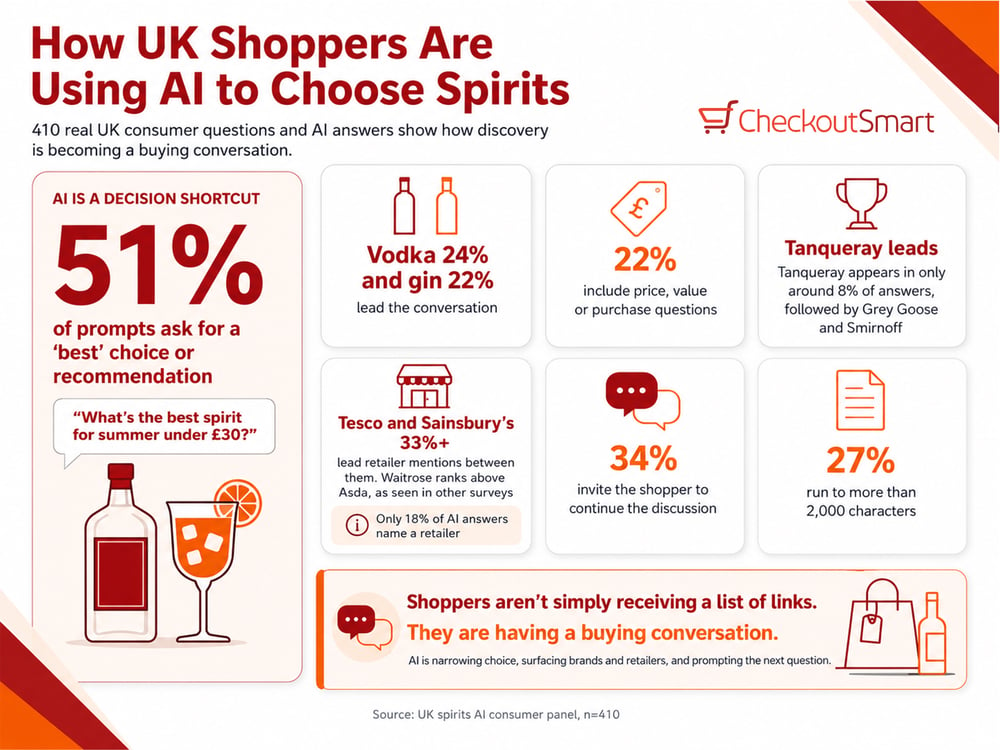
- 51% of prompts ask for a “best” choice or recommendation.
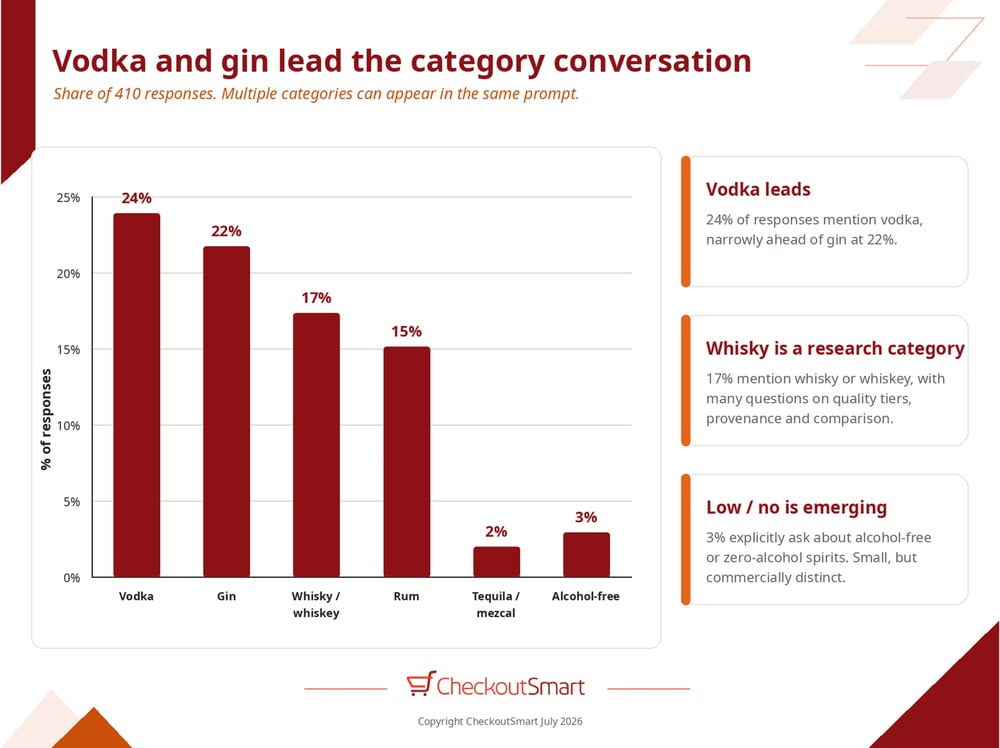
- Vodka and gin dominate the conversation, appearing in 24% and 22% of prompts respectively.
- 22% of prompts include price, value or purchase questions.
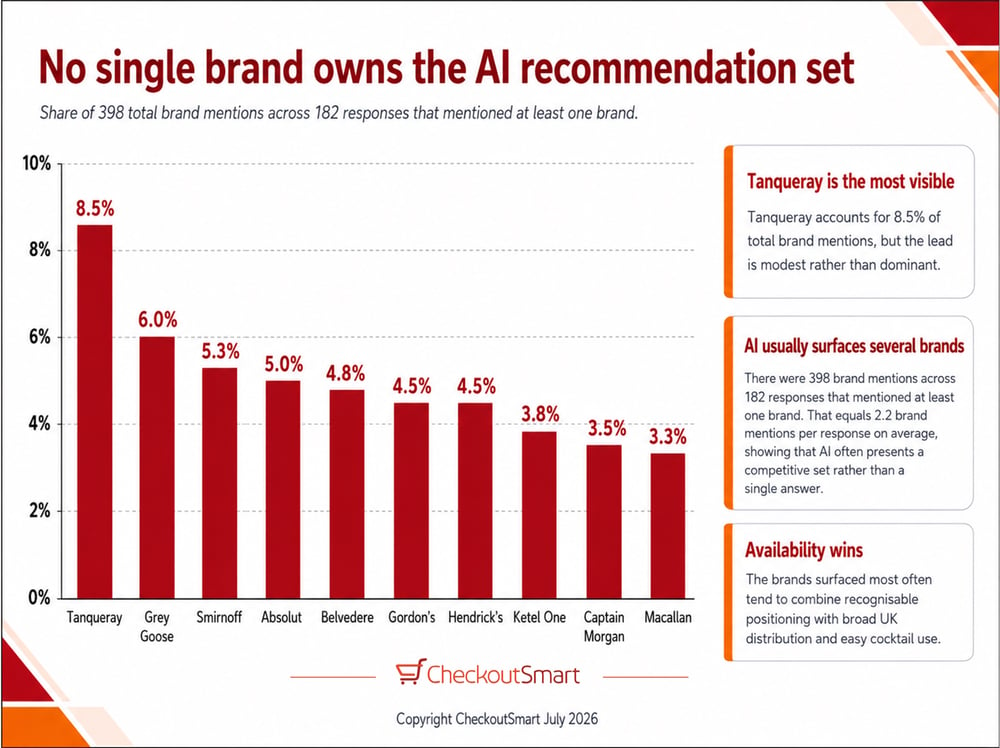
- No brand dominates AI recommendations. Tanqueray leads, but appears in only around 8% of answers.
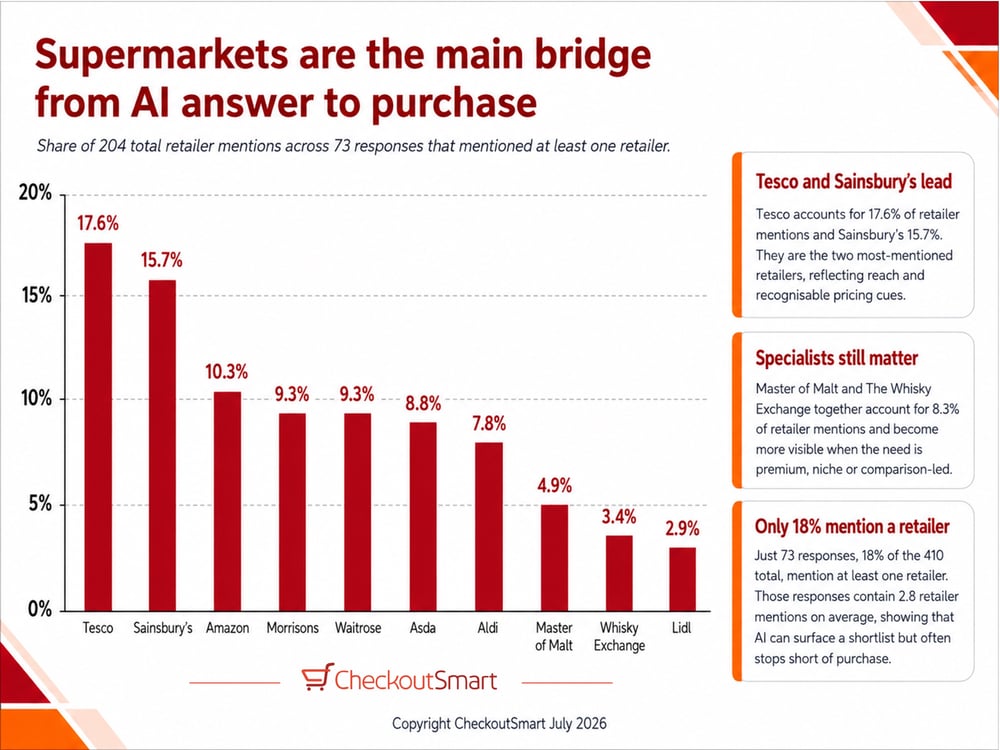
- The journey often stops short of purchase: only 18% of AI answers name a retailer.
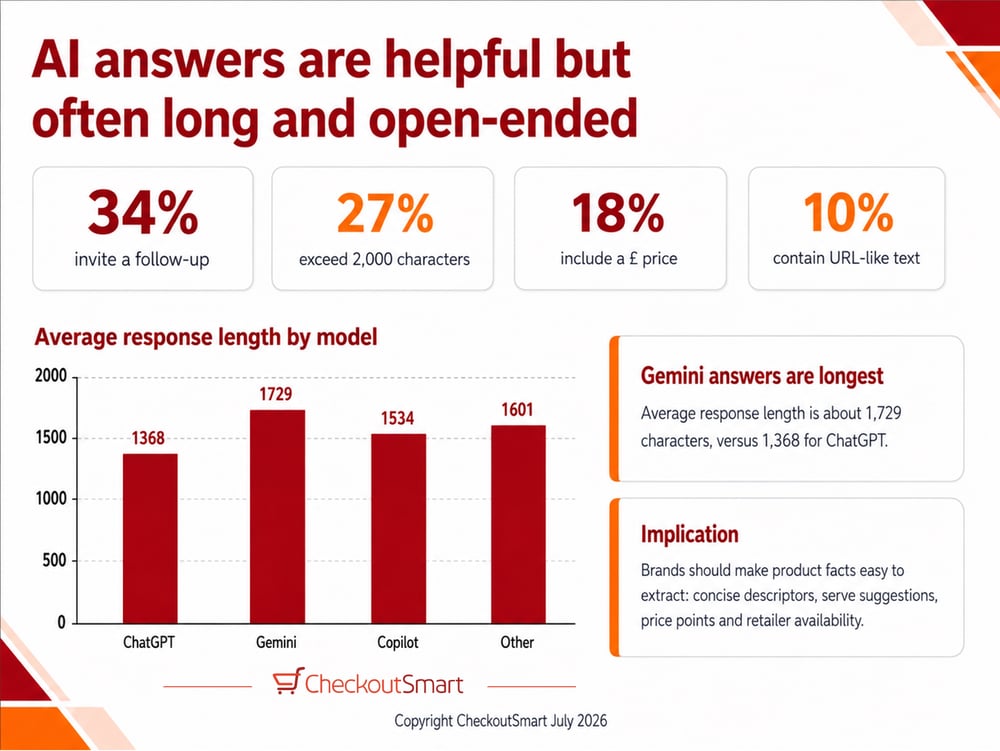
There is another important difference from conventional search. AI is conversational. 34% of answers invite the shopper to continue the discussion, while 27% run to more than 2,000 characters.
AI is already doing the narrowing
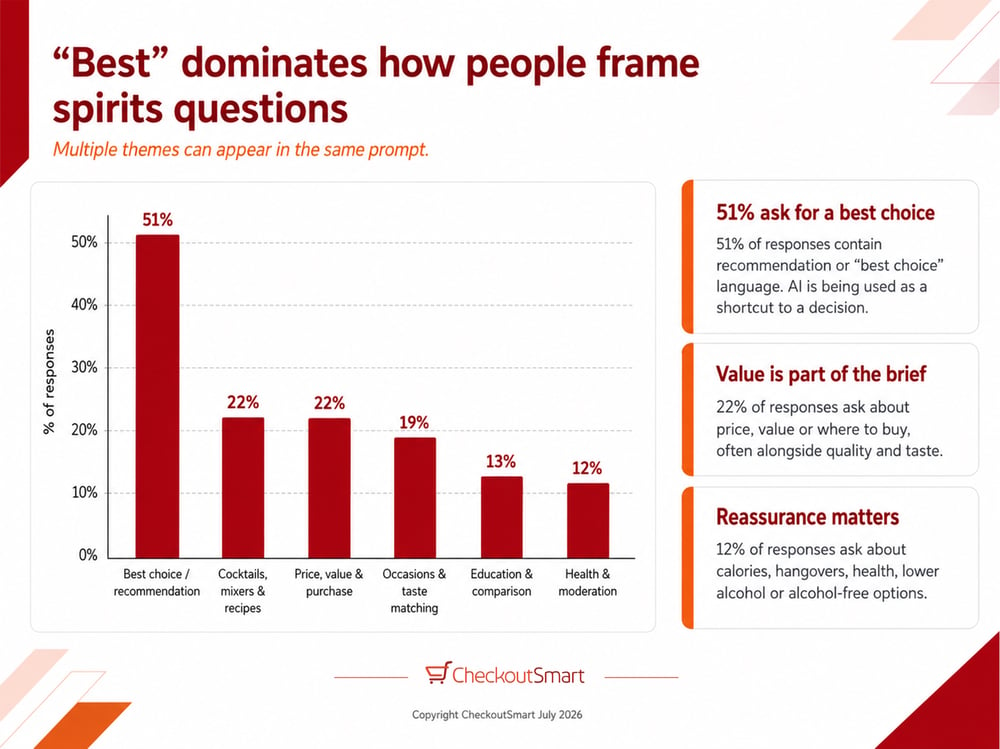
More than half of the questions, 51%, use "best", "recommend" or similar decision language. I think the word "best" is easy to underestimate. It sounds broad, but in these prompts it is often shorthand for a bundle of conditions.
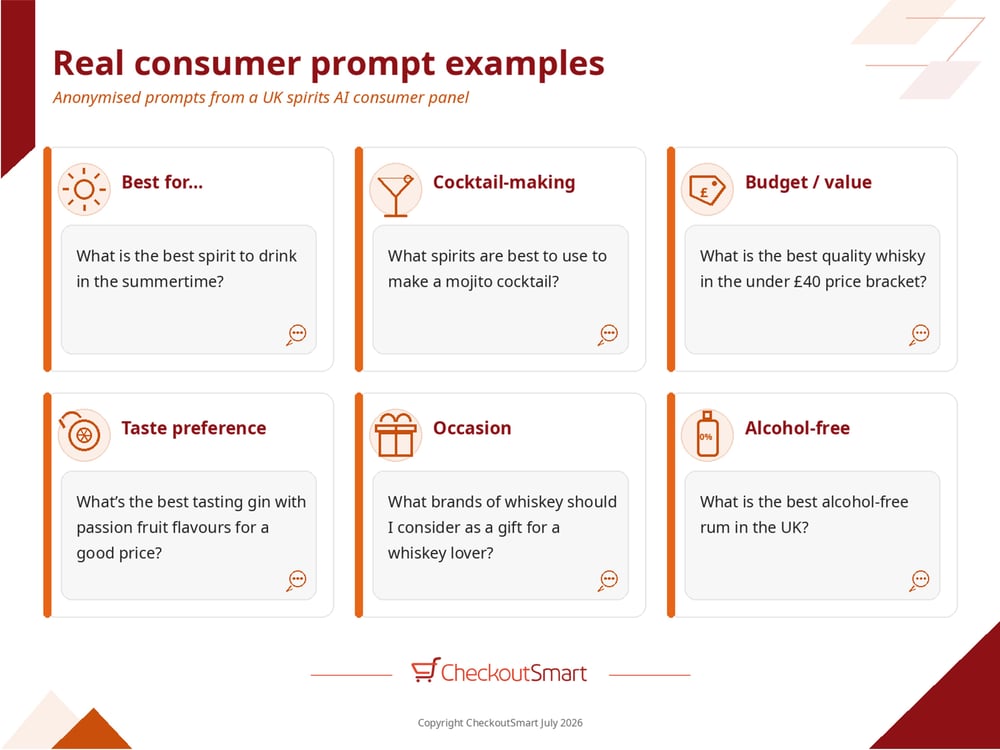
A shopper asking for a "smooth vodka under £30" is not searching for a category leader in the abstract. They want AI to combine taste and price and come back with a manageable answer. "Best rum for mojitos", "gin for a summer party" and a bottle suitable as a gift do the same thing in different ways. That feels much closer to a brief than a search query.
The shopper is handing over part of the comparison process. Commercial intent is already mixed into that brief. 22% of prompts touch price, value or purchase. Another 12% involve reassurance or moderation, including calories, hangovers, health, alcohol strength and alcohol-free options. Those are the moments where a shopper is trying to reduce uncertainty, not just browse the category.
"Smooth vodka under £30" is closer to a buying brief than a search term.
Vodka and gin lead, but the categories behave differently
Vodka appears in 24% of prompts and gin in 22%, so they are the two spirits people most often bring into these AI conversations. Whisky or whiskey follows at 17%, with rum at 15%. The volume is similar, but the questions themselves look quite different. Whisky questions tend to pull AI towards explanation: styles, provenance, quality and price. Rum is more likely to arrive through the back door, via a mojito or another serve.
One shopper starts with the spirit. Another starts with the drink they want to make. Only around a dozen prompts explicitly focus on no or low alcohol. I would not dismiss that as a footnote. Sometimes a small need is precisely where a brand can become easier for AI to place, because fewer competitors have made the association clearly.
We have seen that elsewhere in the AI User Consumer Panel too. The need state can do as much to shape the shortlist as the size of the brand.
Shoppers are not speaking brand-manager
One of the best things about real prompts is how little they sound like industry copy. Shoppers ask for smooth, sweet, fruity, refreshing, good for summer, right for a cocktail, or suitable as a gift. That language is blunt, and useful. "Best rum for mojitos" and "smooth vodka under £30" tell you exactly what job the shopper wants the product to do.
A production-led description may be accurate, but if it never connects to the outcome the shopper cares about, AI has more work to do before it can make the match. Cocktail questions are especially interesting because one prompt can open the door to several spirits, brands and mixers at once. Occasion questions do something similar. A party, a summer serve or a gift gives AI another reason to include one bottle and leave another out.
I would use a very simple test on product content: can a shopper, or an AI system, work out what this bottle is best for without decoding the category's own language? If a gin has a strong role, say it clearly. If a vodka is known for smoothness, connect the brand to that characteristic. If a rum belongs in a particular serve, make the recipe easy to find.
A famous brand still has to earn a place in the shortlist
The brand picture is not a winner-takes-all ranking. Across 398 total brand mentions in the 182 responses that mentioned at least one brand, there were 2.2 brand mentions per response on average.
AI is usually offering a competitive set. Tanqueray is the most visible brand, accounting for 8.5% of total brand mentions. Grey Goose follows at 6.0%, then Smirnoff at 5.3%, Absolut at 5.0% and Belvedere at 4.8%. To me, the fragmentation is the more important story than the exact order. Tanqueray leads, but no brand owns the recommendation set.
Premium vodka makes that obvious: AI has several credible brands it can use, and the wording of the shopper's brief gives it a reason to favour one over another. Being famous helps, but it does not automatically make you the answer. Clear use cases, recognisable positioning and accessible product information give AI something concrete to work with.
AI can get the shopper close to the shelf, then leave them there
Recommendation is only commercially useful if the shopper can act on it. Here the data gets a little awkward: just 73 of the 410 answers, 18%, mention a retailer at all.
Those 73 responses contain 204 retailer mentions, or 2.8 retailer mentions per response on average. Tesco accounts for 17.6% of retailer mentions and Sainsbury's 15.7%. Morrisons and Waitrose are both at 9.3%, with Asda at 8.8%. We have seen Waitrose surface above Asda in other surveys too.
Specialists still have a clear role. Master of Malt and The Whisky Exchange become more visible when the question is premium, niche or comparison-led.
The gap is simple: more than four in five answers do not explicitly connect the recommended bottle to somewhere it can be bought. Price, pack size, stockists and availability can look like ordinary product-page housekeeping, but without them the AI journey can stop one step before the sale.
One answer is often only the opening move
A conventional search result usually leaves you with links. AI often comes back with a question of its own. In 34% of answers, shoppers were invited to continue, usually with more detail on budget, flavour, ingredients or intended serve.
So the first answer often isn't really the answer. A shopper can start with "What is the best gin?" and, two turns later, be talking about a £25 budget, citrus flavours and whether Tesco stocks it. The shortlist can change as the shopper gets more specific.
Some of the answers are long too. 27% run to more than 2,000 characters, yet only 18% include a £ price and around 10% contain URL‐like text. More words do not necessarily get the shopper any closer to buying.
There was also a noticeable difference between platforms. In this dataset, Gemini answers averaged about 1,729 characters, compared with 1,368 for ChatGPT, 1,534 for Copilot and 1,601 for other models.
What I would do next
If I were auditing a spirits brand tomorrow, I would start with the questions rather than the keywords. The data shows shoppers giving AI practical briefs around cocktails, taste, price, gifting, occasion, moderation and comparison. That is the territory the brand needs to be eligible for.
Then I would check what AI actually has to work with. Taste descriptors, cocktail and serve suggestions, ABV, pack size, price positioning, retailer availability, FAQs and clear product information are all useful, but only if they are easy to find and interpret.
-
Start with the questions people actually ask: Build prompt families around cocktail, taste, price, gifting, occasion, moderation and comparison, rather than just "best gin" or "best vodka".
-
Look at who keeps appearing alongside you: You may find the brands AI puts you next to are not the ones you normally think of as your competitive set. Look at what keeps recurring and why.
-
Check where the journey breaks: If AI can explain the bottle but cannot find the price, pack or retailer, the journey is still incomplete.
-
Run it more than once: Small changes in wording and context can change the shortlist. Look for patterns across real consumer behaviour, not a single head‐office prompt.
The CheckoutSmart AI User Consumer Panel does exactly that: it captures real questions and full AI responses, then shows which brands, retailers and sources keep surfacing.
The most useful question for a spirits brand is still a simple one:
If a shopper asked AI today for the best spirit for your brand's key occasion, would your product make the shortlist, and would they know where to buy it?
To find out what shoppers are asking AI in your category, which brands are winning those answers and where the opportunities sit for your range, contact sales@checkoutsmart.com to discuss an AI User Consumer Panel category analysis.